
First Citizens
Committee Members:
David Lancaster
Kathy Parker
Dr. John Griggs

Little is known or documented about the first people who lived in Washington County. The County is “on the cusp”of pre-history documentation. Much is known about Central, Eastern/Gulf Coast, North and South Texas, but we seem to be in the “twilight zone” when it comes to pre-colonial history. Our goal is to gather existing information, climate/vegetation pattern history, artifact collections, etc., revisit
previous archeological sites, develop new ones, then document and analyze as much as possible, looking for common denominators to determine occupation patterns, tools used, how/what they ate, and how they lived. This knowledge can then be used to educate current citizens of Washington County and provide future research
resources.
ACTIVITIES 2026:
Continue detailed excavations and analysis of the various sites, documentation of existing collections and new finds. We will contact the THC and request a re-visit to the 41WT8 (Wn-2) site to establish a record of our findings and eventually publish a report on these findings. The basis for an educational curriculum has been started and will continue to be prepared for use in the future.
ACTIVITIES 2025:



PREVIOUS ARCHEOLOGICAL SITE LOCATIONS AND STATUS:
Research was done to identify previous archeological site locations and status. Per the Texas Historical Commission website. Research determined that Washington County is very under-represented. Several of these sites were reported in the past by Chappell Hill resident and historian, Nath Winfield along New Year’s Creek, north of Chappell Hill. These sites were identified, descriptions and general locations obtained.
LITHIC ANALYSIS:
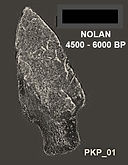
Winfield’s personal collection of Projectile Points, Ceramics and Bone/teeth Fragments from these sites have been graciously loaned to this committee for research and documentation. Identification of the Projectile Points is indicating several “occupation periods” for sites along New Year’s Creek, North of Chappell Hill.
These range from 200 to 6000 years before present (BP = 1950). Lithic artifacts currently being found on the PARKER RANCH (in the same area), also indicate the same age range. Research and documentation are continuing, due to the quantity of artifacts available.
ID BONES:
Faunal remains (bone/teeth) from 41WT8 (Wn-2) Site in the New Year’s Creek area, were sent to IDBones, in South Carolina, for analysis and the report was received. The results confirmed that there were remains from White-tailed Deer (family Cervidae), Canine (family Canidae - the size of the canine appears to be smaller
than a wolf so more like a coyote or dog), and Bison (bison bison as opposed to bison antiquus).
BETA ANALYTICS:
Selected faunal remains (Bison teeth) from 41WT8 (Wn-2) Site in the New Year’s Creek area, were sent to Beta Analytics, in Miami, Florida, for Radiocarbon Dating and Stable Isotope Analysis. The Bison tooth sample, was dated 1350 AD +, - 30 yr (this is within the Toyah Phase of 1250 AD - 1700 AD), the Stable Isotope Analysis showed that the area climate in which this Bison lived (the 14 th century), was considerably cooler and drier than that of Central Texas as indicated in the study by Lohse et al, in 2014, of Toyah Phase and others. This difference begs more investigation.
FLINT KNAPPING:
Conducted a Flint Knapping demonstration by Angus Dunn in October at the Chappell Hill Museum. There were approximately 25 attendees, with positive feedback. Potentially, repeat demonstrations will be conducted.
ULTRAVIOLET (UV) FLORESCENCE:
Many minerals react to Short and Long Wave Ultraviolet Light differently (such as Edwards Chert). This reaction can help in identifying the physical location from which the material comes. This material source identification in turn, can aid in understanding whether lithic material was local, or possible “trade goods” from other areas. We obtained UV lights of various wavelengths to analyze the lithic artifacts, using existing references as well as to develop a local material data base.
CERAMICS:
There are several different types of materials used in the ceramics in the existing collections to which we have access. Several methods can be used to identify the material and its probable source. As with the lithic material, ceramic material source identification can aid in understanding whether the ceramic material was local, or possible “trade goods” from other areas. We have begun the process of obtaining “Thin Section” samples from Nath Winfield’s original Site Wn-2 (41WT8) by sending four different types of sherds to National Petrographic Services. These will be used
for future analysis. Identified several “fired-clay nodules” from the PARKER RANCH which may indicate the use of a hearth.
PARKER RANCH:
An occupation site was found by this committee on Kathy and Clay Parker’s property. Continuing excavation and screening have revealed lithic artifacts (points and flakes, etc.) as well as ceramic sherds. One of the lithic points is made from a “Mystery material” which was analyzed at Chemjet International, using Laser-Induced Spectroscopy and later identified as Opalized Palmwood – from the Catahoula Formation. This material is not locally available, therefore it is a probable “trade good.”
RE-EXCAVATION OF 41WT8 (WN-2):
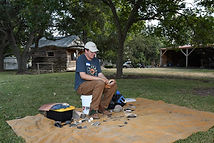
We have gained access to Nath Winfield’s original Site 41WT8 (Wn-2) which was documented by the THC 54 years ago in 1971. We made an initial reconnoiter of the site (70 x 30 yds) and began “shovel tests” using hand auger, later a power auger and the land owner’s backhoe. The original site has not yet been found, but our excavations in other areas near there have revealed a buried prehistoric site with
evidence of intact deposits of cultural remains stratified at three different depths below the ground surface. We expect others.

